


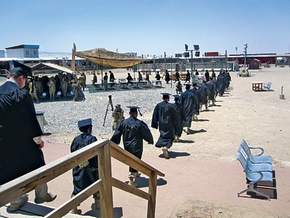
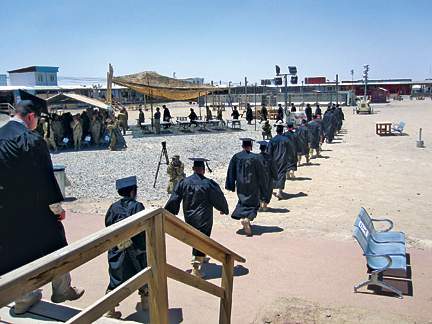
Photo by Lisa M. Henkel, UMUC
UMUC students participate in a
combined graduation ceremony in
Kandahar, Afghanistan last May.


When Gregory Barber recommends the University of Maryland University College to fellow veterans immersed in a college hunt, he offers them one simple reason why they should consider UMUC.
“I had an academic advisor in a war zone,” said Barber, who enrolled in UMUC courses throughout his 20-year U.S. Air Force career, including his stint in Bosnia during the 1990s conflict there. “They were right there with us, helping us, giving us access to education no matter where we were. Evidently, they care that much. We recognized that.”
Service to the veteran student community began with UMUC’s founding in 1947, when the school educated veterans who had returned from World War II. The institution has worldwide reach in today’s military—a tradition that began two years after the university’s founding, when a group of faculty members traveled to Germany to establish an extensions program for troops, according to a military heritage video on UMUC’s website.
UMUC, which now serves more than 55,000 military-affiliated students in 25 countries around the world, was the first university to offer overseas education to service members, according to the university’s website. The university has forged 14 military educational partners, including the Air War College, the Naval War College, and the Marine Corps College of Distance Education and Training.
The school’s reputation in military circles and the ease of access to higher education has drawn Barber, a Brandywine, Md., resident, back to UMUC for courses even after his retirement from the armed forces in 2008. Having already earned a bachelor’s in information systems management and a Master of Business Administration from UMUC, Barber is now pursuing a degree in cybersecurity policy—a move that will help him progress in his job as an IT contractor in Columbia, Md.
The university’s faculty, said Barber, has always made him feel welcomed in the virtual classroom. Barber has never struggled to get in touch with a UMUC professor or instructor, and he never feels like a nuisance when he asks questions to clarify lectures or prepare for exams.
“That’s the reason I keep coming back,” Barber said. “To go in knowing someone is going to care about you … and your success—that’s a big thing for a lot of vets.”
James Cronin, an instructor and associate vice president for military partnerships at UMUC, said the university made a commitment to cater to veterans with the understanding that they were the least traditional college students—always ready to move to a new state or continent in a moment’s notice. Their education, he said, had to be portable and accessible from anywhere at any time.
“Our roots are in service to the military,” Cronin said. “Part of the reason we were established in 1947 was to serve nontraditional students.”
The university has maintained goodwill in the military community in part, said Cronin, because advisors don’t shoehorn veterans into ill-fitting academic programs. Instead, they work closely with incoming students, making sure their GI Bill benefits are put to good use.
“We are all about helping vets understand their benefits and getting them in a program that fits their educational goals,” he said.
barber said he has become a part-time
evangelist for UMUC’s various veterans’ programs over the past two decades, convincing fellow veterans that their college search should begin and end with UMUC.
Veterans shopping for colleges are so often wooed by institutions hoping to secure the service member’s GI Bill benefits that veterans can make the wrong choice without a thorough examination, Barber said.
Barber, now 47, said that during his college search in the mid-90s, it was UMUC’s commitment to military members that helped distinguish the university from other options.
“A lot of schools want their money, but I don’t think they really give a strong pitch to vets. We’re very aware of how attractive our benefits are,” he said. “I never got the warm fuzzies with a lot of colleges back then. If I go in and feel like they’re not really welcoming me, I’m probably not going to go back. I felt different with UMUC.”
According to Cronin, UMUC avoided resting on its laurels and depending on its good reputation among veterans to remain intact by constantly gauging the educational needs of current and former service members. That was a driving force behind the school’s launch of its 2010 cybersecurity program, which has drawn more than 5,000 students, he said—many of them active duty and retired veterans—in its first two years.
THE university introduces potential students to a program called UMUC 411, designed to let them test-drive online classes to see if they could succeed in the nontraditional classroom. UMUC also devised a tailored UMUC 411 experience, said Cronin, for military veterans considering enrollment in hopes of familiarizing service members with their educational surroundings during their transition to civilian life.
According to Barber, fear of the unknown has kept many of his service-member friends from enrolling in college and using their government benefits. The prospect of being without fellow veterans, Barber said, is one that many retired soldiers can’t overcome.
“I always tell them, ‘If you can go to war overseas, you can come to school and learn and pass classes,’” he said. “I tell them that ‘if I can do it, you can do it.’”
The university will soon introduce an online student club specifically for military veterans, according to Cronin. Students will have a forum to discuss common challenges faced during the sometimes-difficult transition from the battlefield to the classroom, whether it’s brick-and-mortar or virtual.
Having a support group of fellow veteran students, Barber said, is perhaps the most effective welcome mat a school can roll out for incoming students. He said UMUC’s expansive military population has always been an effective recruitment tool.